The Tri-View System
Tri-View
Tri-View is a research-based precision targeting, multi-timeframe system for finding high-quality trade entries.
What is Tri-View?
Tri-View is a research-based, precision targeting, multi-timeframe system that helps traders find ideal entries, improve their trade quality and risk management, and use both their time and capital more efficiently.
Instead of treating every setup the same, Tri-View gives each trade a clear intention, the right timeframes and a grade, so you only consider setups that are qualified. Its structured rules let you spot those setups quickly, straight from the chart. No hoping, no guesswork.
Tri-View also makes you grade the market before you commit capital. Like a fisherman checking the weather forecast, you head out to sea only when the weather is good, and stay in port to protect your gear when the market turns stormy. Your capital is deployed when conditions support it, and protected when they don’t.
Think of Tri-View as your radar: it helps you navigate the market efficiently, make the most of your time and capital, and improve the quality of every trading decision.
What makes it different
Rules-based · Research-based · Precision targeting · Only the best entries
Every rule is something you can see and check on the chart: moving averages, timeframes, a grade, a market score. No hidden concepts, no jargon, no guesswork.
Built on research
Research-based & rules-based: built on years of TA research and analysis of years of real trades. No guesswork, no jargon.
Tri-View wasn’t invented. It was researched.
- Years of technical analysis study and practice: volume price analysis (VPA), Wyckoff and multi-timeframe analysis, distilled into a few rules you can check on any chart.
- Years of real trades, analyzed one by one: what wins and how to repeat it, what loses and how to avoid it.
The result is a method where every rule has a reason, and every reason came from the charts and the trade log.
The problems Tri-View solves
The trade research exposed these problems; patterns that cost traders the most.
| The problem | How Tri-View solves it |
|---|---|
| No clear intention. | Every trade must start with a clear purpose and a declared play (VEST, SWING, TREND or HOLD). |
| Choosing wrong timeframes, causing confusion and distraction. | Each play type decides its own timeframes, so you always know which charts to read. |
| Treating every setup the same, or impulsive trading. | A structured A / B / C grade separates the qualified setups from the average, weak and bad ones. |
| Trade drift, or letting losses get bigger on hopes. | A trade changes play only through a deliberate, rules-based cascade, never out of hope. |
| Trading against the markets. | A daily market score sets your mode (Aggressive, Selective or Defensive), so your capital works when market conditions are good and stays protected when they’re not. |
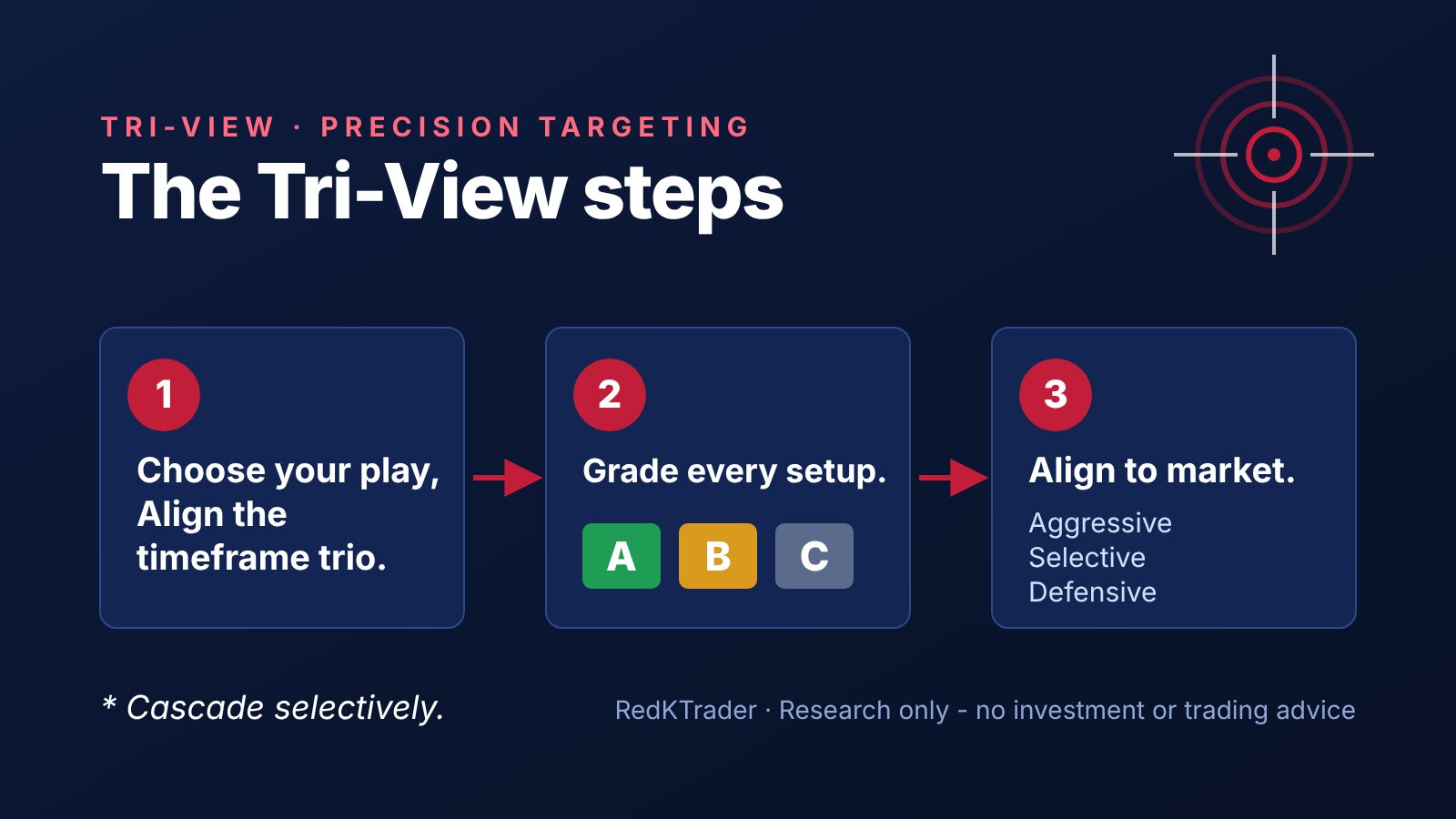
The Tri-View steps
- Choose your play, Align the timeframe trio.
- Grade every setup.
- Align to market.
* Cascade selectively.
Before you start
Tri-View builds on the core concepts of classical technical analysis: trend, structure, volume and multiple timeframes. These foundations are covered in Track 1 of the TACT coaching series - and are valuable for further TA studies after the series.
Tri-View FAQ
What is the Tri-View System?
A research-based precision targeting, multi-timeframe system for finding high-quality trade entries. Clear rules give each trade an intention, the right timeframes and a grade, and check the market first, so you act only when the chart setup meets the entry criteria and the market supports it.
Where did the Tri-View System come from?
Tri-View is research-based. It’s the result of years of technical analysis study and practice (volume price analysis, Wyckoff, multi-timeframe analysis), and years of real trades analyzed one by one: what wins and how to repeat it, what loses and how to avoid it.
What makes the Tri-View System different?
Rules-based: every rule is something you can see and check on the chart, with no hidden concepts or jargon.
Precision: setups are graded A, B or C, and “no trade” is a valid answer. No guessing.
Regime-aware: grades the market before any capital is committed.
How does the Tri-View grading work?
1. Three checks across two timeframes, in a structured order, give a grade: A (full alignment), B (partial) or C (no trade yet).
2. Market regime assessment determines your mode: Aggressive, Selective or Defensive. Checked before you trade.
With practice, you will look at a chart and grade it on the spot.
Do I need special indicators or coding skills?
No. Tri-View runs on indicators that any charting platform can draw, and no coding skills are required. A dedicated Tri-View Pro indicator will soon be available for added convenience – but optional.
Does Tri-View tell me what to buy or sell?
No. Tri-View is a method for reading and grading chart setups, not a signal service. We coach the method on past and practice charts; you apply it to the markets you choose. Research only - no investment or trading advice.
What do I get during the coaching?
Hands-on practice in every session: you set up your charts, grade setups, score the market and get feedback on your own work, in small groups. You also receive the slides after each session, a one-page Tri-View cheat sheet and the Tri-View Playbook.
What are the four plays?
VEST, SWING, TREND and HOLD. Each play has its own purpose, holding time and set of three timeframes (Context, Analysis and Execution). You declare the play before you enter, so you always know which rules apply to the trade.
Which markets and timeframes does Tri-View work on?
Tri-View is market-agnostic: the same rules apply to stocks, ETFs, indices, futures, forex and crypto. The four plays cover holding times from minutes to months, and each play has its own timeframe trio.
What do I need to know before starting Tri-View?
The core concepts of classical technical analysis: trend, structure, volume and multiple timeframes. These are covered in Track 1 of the TACT coaching series.
I’m an experienced trader. Can I start directly with Tri-View?
Everyone starts with Track 1, whatever their experience. Tri-View builds on those foundations, and Track 1 makes sure every participant reads the chart the same way and uses the same language before the method is applied.
Is there a price for Tri-View on its own?
Tri-View is taught through the TACT coaching series. See the Coaching page for how to join.
Trade less. Trade better. Tri-View tells you when to head out, and when to stay in port.
Research only - no investment or trading advice.