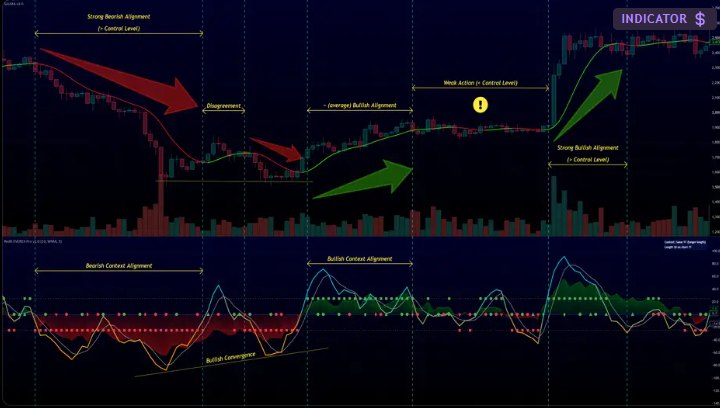
Every price change is the result of an effort. Volume is the effort: how much was traded. Price progress is the result: how far the market actually moved. Richard Wyckoff’s law of effort versus result says the two should be in harmony. When they are not, pay attention.
Four combinations worth knowing
| Effort (volume) | Result (price move) | What it can mean |
|---|---|---|
| High | Large | Serious participation. The move has effort behind it. |
| High | Small | Absorption. One side is actively countering the other’s effort. |
| Low | Large | Ease of movement, a move with little resistance to it. |
| Low | Small | Indifference. Neither side is interested or committed. |
We judge volume and price against their own recent ranges
On a price chart, everything is relative. “High volume” only means something compared with what is normal for that symbol right now. A useful habit is to compare each bar’s volume with the range of the last few bars rather than with a fixed number. Quiet markets and active markets will then produce different “relative” readings.
Where it may go wrong
- Reading one bar in isolation. Effort and result make sense only in the context of recent changes around them.
- Treating absorption as a reversal signal. It is a reason to watch, not a reason to act.
- Ignoring the trend. Volume-price analysis tells you about the quality of a move, not its direction.
This idea is the foundation of EVEREX and VADER, and of the volume-price analysis sessions in the TACT coaching series.
Research only - no investment or trading advice. This article describes how price and volume can be read; it is not a trade recommendation.